In the January 1966 issue of Communications of the ACM, MIT's Joseph Weizenbaum described ELIZA, a pattern-matching program with no representation of meaning whatsoever, and reported something more consequential than the program itself: people talking to it came away believing they had been understood. Weizenbaum wrote in that paper that some subjects proved very hard to convince ELIZA was not human, an observation relayed in a recent Smithsonian magazine retrospective. This is the earliest well-documented instance of a computing system producing a durable false belief in ordinary people about what it was, what it knew, and what it intended, and the author of the system spent the following decade arguing that the effect was a danger rather than an achievement.
What the program actually did
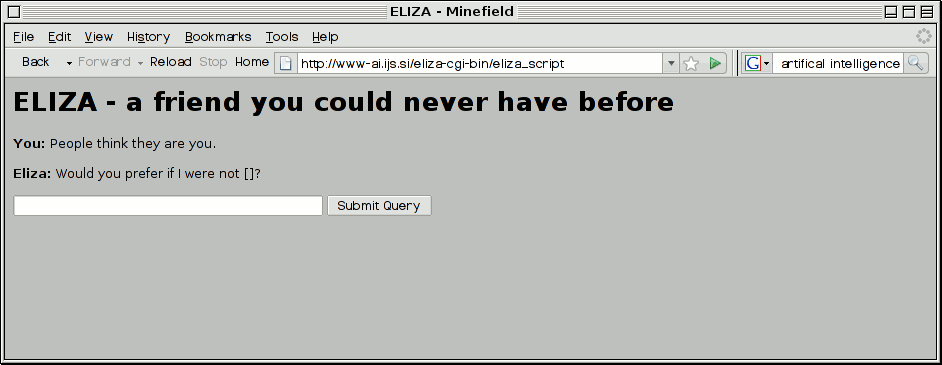
ELIZA ran on the MAC time-sharing system at MIT and was written in MAD-SLIP for the IBM 7094, per the text of Weizenbaum's paper. Its method was mechanical: scan a typed sentence for keywords, apply a decomposition rule to split the sentence around them, then rebuild a reply with an associated reassembly rule. When no keyword matched, it fell back on content-free prompts inviting the user to continue. The behaviour was governed by an interchangeable script, and the script that made ELIZA famous was DOCTOR, which reflected the user's own words back in the manner of a Rogerian psychotherapist.
Weizenbaum was explicit that the therapist pose was chosen for engineering convenience rather than clinical ambition. A psychiatric interview, he argued in the paper's discussion, is one of the rare conversational settings in which one party can plausibly claim to know almost nothing about the world and still be taken seriously. That asymmetry let a program with no world model at all pass as a competent conversational partner. The paper's own framing is unusually candid about this: Weizenbaum opened by saying his object was to strip the magic from the program by explaining exactly how the trick worked.
The reaction Weizenbaum did not expect
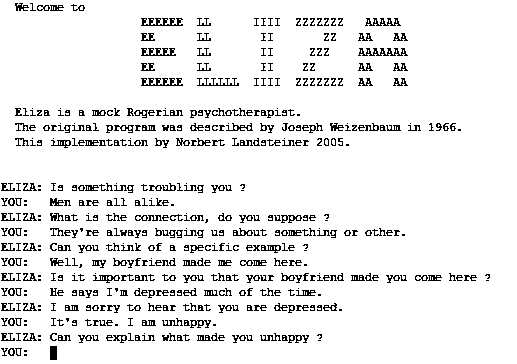
Explaining the trick did not dissolve it. Weizenbaum's best-known account is of his own secretary, who had watched him build the program and knew what it was, asking him to leave the room after only a few exchanges so she could continue in private. He recounted the episode in interviews decades later; a recording of him telling it appears in the 99% Invisible episode on the ELIZA effect.
That anecdote should be handled with care, and researchers working directly with Weizenbaum's papers have said so. The ELIZA Archaeology project, run by David M. Berry and Sarah Ciston, notes that the story reaches most readers through Weizenbaum's 1976 book rather than the 1966 paper, that the unnamed secretary has often been conflated by later writers with a separate "young lady" whose transcript Weizenbaum also published, and that neither woman has ever been identified by name. The project's work on Weizenbaum's personal archives is an attempt to establish who they actually were. The core claim, that people who understood the program's mechanism still behaved as though it understood them, is consistent across the paper and every later account; the specific staging of the secretary scene is reported but not independently confirmed.
From laboratory curiosity to clinical proposal
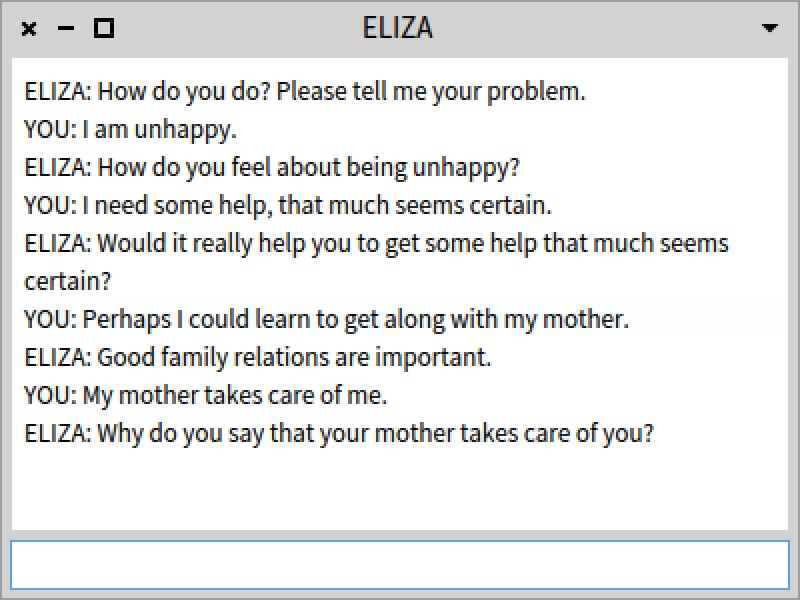
The more consequential response came from the profession ELIZA was imitating. Kenneth Colby, a Stanford psychiatrist and a friend of Weizenbaum's, argued that a descendant of the program could deliver real therapeutic value, an idea with obvious appeal to underfunded institutions where patients rarely saw a clinician. The 99% Invisible account describes peer-reviewed psychology articles in the late 1960s and early 1970s treating automated therapy as a potential breakthrough, and Carl Sagan later imagining networks of psychotherapy terminals. Smithsonian reports that Weizenbaum came to find the proposition repellent and that his public break with Colby was bitter and personal.
Weizenbaum's objection was not that the program worked badly. It was that a keyword matcher with no comprehension could already occupy a role built entirely on being understood by another mind, and that professionals were prepared to hand the role over on that basis. Smithsonian quotes his 1976 book to the effect that short exposure to a simple program could induce powerful delusional thinking in quite normal people; he spent the rest of his career pressing that point, along with warnings about machine listening and automated surveillance.
In his own words
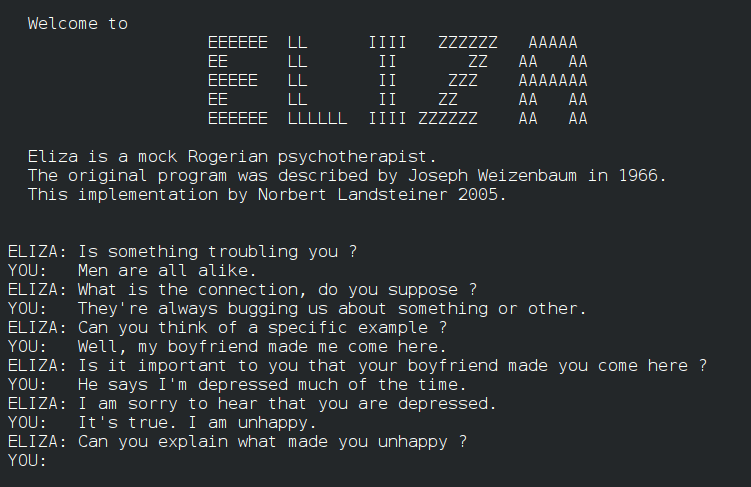
The 1966 paper already contained the analysis that later became known as the ELIZA effect. Weizenbaum located the illusion not in the machine but in the user, who supplies the intelligence and then credits it to the other party:
The speaker furher defends his impression (which even in real life may be illusory) by attributing to his conversational partner all sorts of background knowledge, insights and reasoning ability.
Joseph Weizenbaum, Communications of the ACM, January 1966 (online transcription; "furher" appears as shown)
Telling the story of his secretary years afterwards, Weizenbaum described the moment the demonstration stopped being a demonstration:
After two or three interchanges with the machine, she turned to me and she said, "Would you mind leaving the room please?"
Joseph Weizenbaum, quoted in 99% Invisible, "The ELIZA Effect"
Timeline
- Jan 1966Joseph Weizenbaum publishes "ELIZA - a computer program for the study of natural language communication between man and machine" in Communications of the ACM, vol 9, no 1, pp 36-45, describing the DOCTOR script and reporting that some subjects were very hard to convince the program was not human.
- 1964-1966 (inferred)Weizenbaum's secretary, who had watched him develop the program, asks him to leave the room so she can continue her conversation with it privately. The date is inferred: Weizenbaum published the episode only in 1976 and never fixed its date, but it necessarily occurred during ELIZA's development and early use at MIT's Project MAC.
- 1966-1975Stanford psychiatrist Kenneth Colby and others promote automated psychotherapy built on ELIZA-style programs; psychology journals and popular science writing treat the idea as a plausible breakthrough.
- 1976Weizenbaum publishes Computer Power and Human Reason, arguing that brief contact with a simple program can induce delusional thinking in ordinary people and that some tasks should not be given to machines regardless of feasibility.
- Dec 201999% Invisible airs "The ELIZA Effect", including archival audio of Weizenbaum recounting the secretary episode.
- 20 Mar 2024The ELIZA Archaeology project (David M. Berry and Sarah Ciston) publishes work on Weizenbaum's personal archives noting that later writers have conflated the unnamed secretary with a separate "young lady" transcript, and that neither has been identified.
- 15 Jan 2026Smithsonian magazine publishes a retrospective on Weizenbaum's turn from AI researcher to AI critic, quoting his 1966 paper and 1976 book.
Why it moves the needle
ELIZA caused no injury and touched few people directly, and by any measure of realized harm it is a minor entry. Its weight is entirely in precedent. It is the first case on record in which a deployed system, working exactly as its designer intended, reliably produced false beliefs in users about its own nature, and the first in which that misplaced trust was immediately proposed as the basis for deploying such systems in a safety-critical human role. Both halves of that pattern recur in every subsequent generation of conversational systems, including current reports of chatbot-reinforced delusion and of therapeutic products built on language models.
The failure mode is also unusually resistant to the obvious fix. Weizenbaum's paper was written specifically to explain the mechanism away, and the explanation did not stop his own colleagues and staff from anthropomorphising the result. Transparency about how a system works turns out to be a weak defence against the impression that it understands. That is the finding sixty years of chatbot deployment has not overturned.
A note on sourcing
The ACM's canonical record for the paper is its DOI landing page, which is not retrievable as plain text; the full-text version cited throughout here is a long-standing online transcription hosted by the University of Maryland, Baltimore County, which is abridged in places and carries at least one obvious typographical error in the citation line (it gives the page range as 36-35 rather than 36-45).